In 1776, Philip Yorke (1743-1804) observed that ‘running … into Welsh Antiquities’ was the result of ‘a promise I made to Mr. Pennant, to investigate those of my neighbourhood’.1 By the mid-1770s, Yorke was the owner of Erddig Hall [fig. 1] just outside Wrexham, the starting point for this manuscript tour, as well as for several of his longstanding research interests (Wat’s Dyke, for example, runs through Erddig Park). His correspondence with Thomas Pennant in the 1770s focused on a number of their shared interests, including topographical, geological and antiquarian subjects particularly connected with north-east Wales, such as gentry family history and the earthworks known as Offa’s Dyke and Wat’s Dyke.2
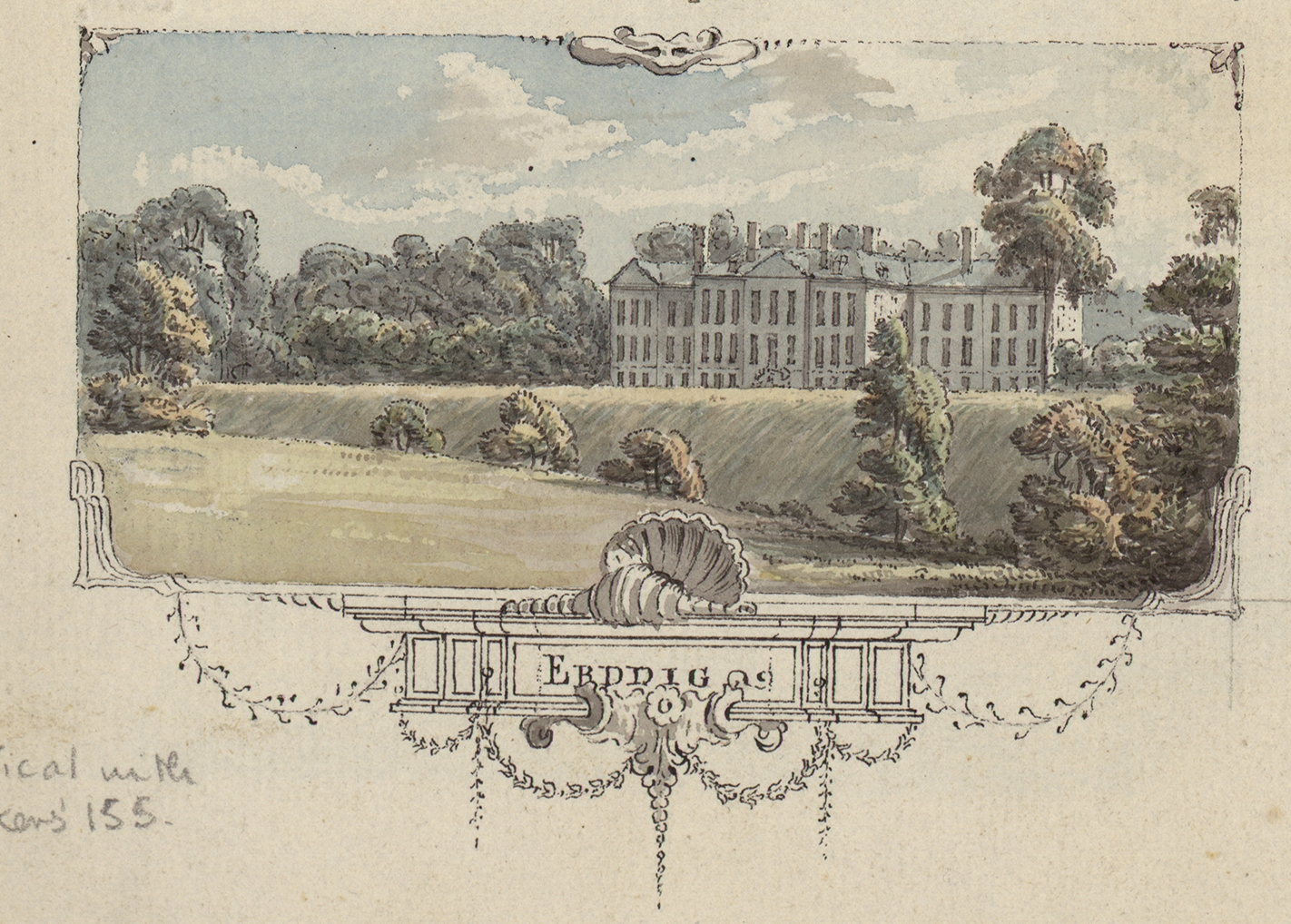
Yorke’s ‘promise’ was part of an ongoing commitment to Welsh history that would in time result in the publication of Tracts of Powys (1795), dedicated to Pennant, and The Royal Tribes of Wales (1799), works he envisaged as a part of a multi-volume (but ultimately unfinished) ‘Biography of Wales’.3 By the mid-1770s, Yorke had made several tours of north Wales in which travel functioned as a form of practice-based research or fieldwork. But the evidence of this relatively early 1766 tour, made when Yorke was 23, also suggests that his historical, cultural and antiquarian interests took root early on. Yorke received a typical gentleman’s education in Eton and Cambridge, whose classical content may have had a shaping influence on his later scholarly pursuits.4 Born and raised in Erddig, however, he also – like his mentor Pennant before him – identified as Welsh, not least through patriotic expressions of Welshness in his published works.
Yorke inherited Erddig on the death of his father in 1767, and though he could not have known it at the time, this Welsh tour therefore took place not long before the life-changing point at which he assumed responsibility for the estate. He does not mention his travelling companions by name in the 1766 manuscript but a later letter to Pennant reveals that it was made in the company of Brownlow Cust – his Eton and Cambridge contemporary and future brother-in-law – along with a Dr Cust and Mr Kent. Leaving Erddig on 13 August, the party travelled west into Denbighshire (Ruthin, Denbigh), through the Conwy Valley and on to Caernarfon and (briefly) Anglesey, before returning via Cader Idris, Bala and Corwen. The tour lasted four weeks, and includes a wide range of reportage and commentary, from glimpses of Yorke’s sociable gentry world in assize balls and private dinners, to accounts-in-passing of castles, cathedrals and their administrative histories, to enthusiastic descriptions of landscape (notably along the River Conwy and in the Beddgelert area).
Though comparatively brief at just under 5000 words, Yorke’s tour is a lively patchwork of places, significant local figures and histories, and topographical detail. Its antiquarian aspect also, however, raises the question of why it was put to paper. An extensive passage of transcription involving genealogies at Gwydir Chapel near Llanrwst perhaps suggests that it was an aide memoire as well as a fact-finding or pleasure-seeking trip, in which Yorke was first becoming seriously interested in topics that he would later pursue at length. The tour proper concludes with an intriguing letter in Yorke’s hand but almost certainly written by another member of the travelling party – perhaps Brownlow Cust? – which describes their visit to Llangollen, and recounts local legends in which the hill under Castell Dinas Brân contains not just ‘great treasures … concealed in an Iron Cradle, a considerable depth in the ruins’ but also the Devil himself guarding them.
Notes
1 Philip Yorke to the Earl of Hardwicke, 1776, quoted in Eric Griffiths, Philip Yorke I (1743-1804) Squire of Erthig (Wrexham: Bridge Books, 1995), p. 144.
2 For letters from Yorke to Pennant in the 1770s, commenting on research-in-progress on Wat’s Dyke, see here.
3 Yorke envisaged ‘a Biography of Wales, a Country which hath never been wanting of great men and correspondent events through many generations’. Quoted in Griffiths, p. 153.
4 Ibid., p. 21.
Note on the source text
The manuscript source is a fair copy written in Philip Yorke’s generally clear hand on recto pages, with occasional explanatory notes on facing recto pages. The source text is unpaginated, therefore page divisions are present but not numbered in this edition.
Further reading
- Eric Griffiths, Philip Yorke I (1743-1804) Squire of Erthig (Wrexham: Bridge Books, 1995)
- Dodd, A. H., (1959). YORKE, PHILIP (1743-1804), of Erddig (or Erthig), Wrexham, antiquary. Dictionary of Welsh Biography. Retrieved 6 Jun 2019.