In the summer of 1805, the 22-year-old Cornelius Varley sat in the Vale of Llanllyfni, with Snowdon some seven miles to the east of him, and contemplated the sky. Visiting Wales in the middle of a prolonged rainy spell, Varley, a watercolourist and maker of scientific instruments, was trying to understand the workings of the clouds he could see moving and shapeshifting over Snowdonia. He turned to a theory of electricity in order to do so, proposing that clouds, and rain, were governed by a system of charged electrical particles.
Varley was born in Hackney in 1781, a younger brother to John Varley (1778-1842), who as an artist would turn out to be the better-known of the two men. The early death of their father resulted in John Varley being apprenticed to a painter, while Cornelius Varley was raised by and in turn apprenticed to his uncle, Samuel Varley, a watchmaker, maker of scientific instruments and scientific lecturer. Varley describes this background, and his precocious skill in making his own scientific apparatus – especially lenses and microscopes – in the early part of this undated tour-memoir. By 1811 he would have invented and patented the graphic telescope, a drawing aid in the form of a device that magnifies the subject to be drawn and projects it onto paper.1
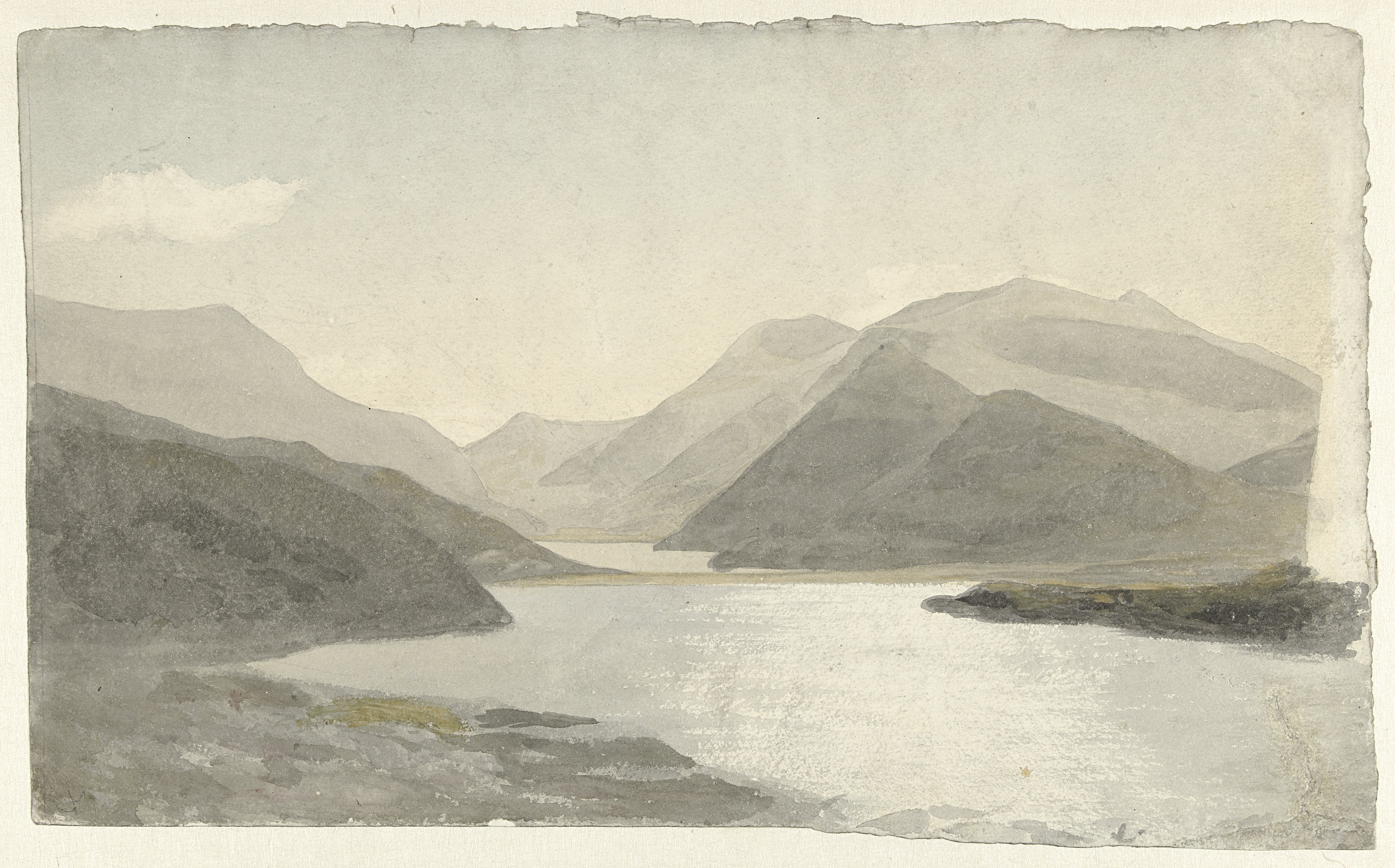
Varley’s 1805 visit to Wales was one of several Welsh tours he made just after the turn of the century in the company of his brother and other artists, including Joshua Cristall (1767–1847) and William Havell (1782-1857), almost certainly in order to sketch landscapes from real life. Little information survives about the Varley brothers’ 1802 tour but drawings and watercolours dating from this year, including of Llangollen, Barmouth and Conwy Castle, suggest a typical itinerary for this period. Several undated sketches, including a view of Llanberis (fig. 1) that shows Cornelius Varley’s spare and sensitive view of landscape, almost certainly date either from this tour or those that followed it in 1803 and 1805.
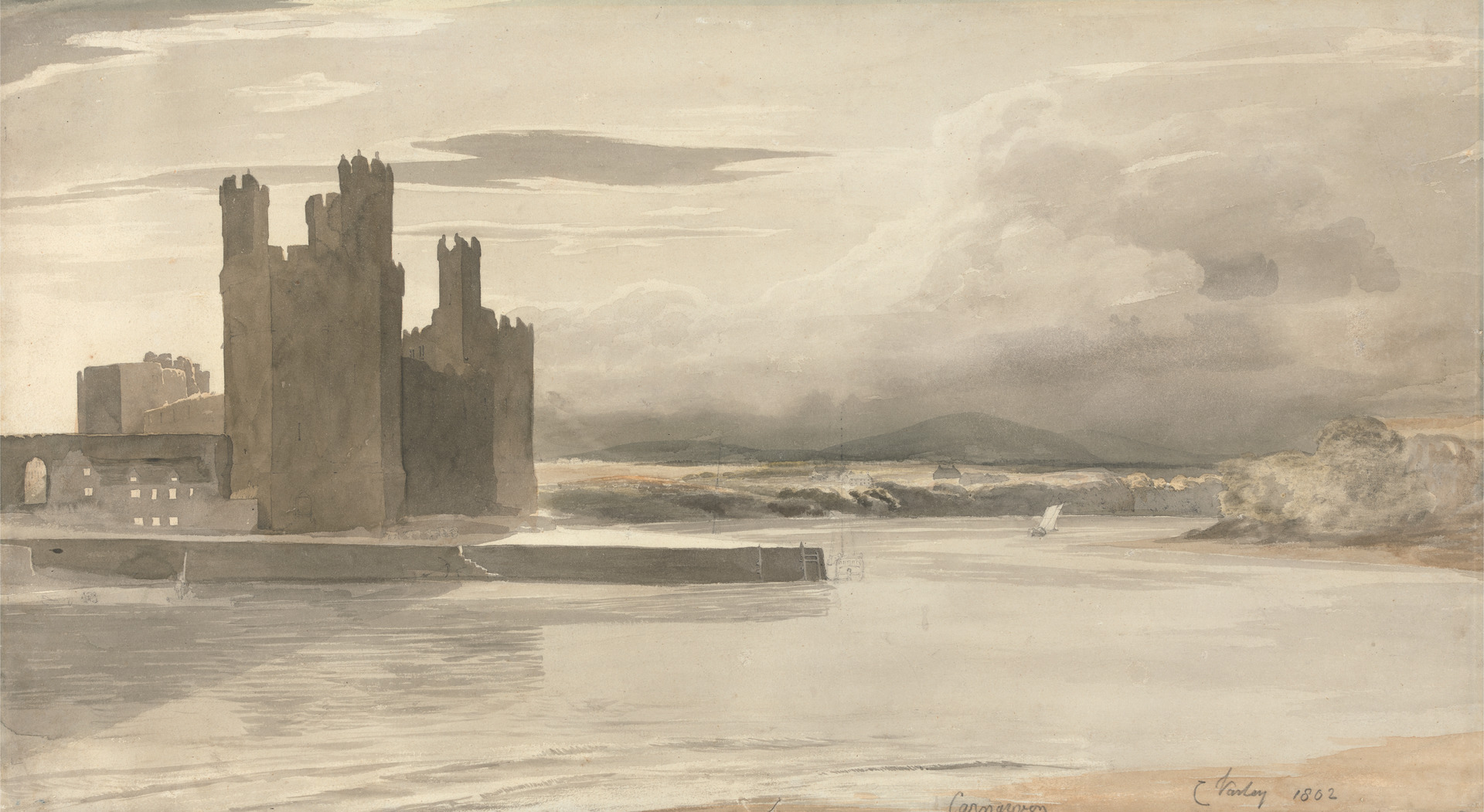
Varley’s grey washed ‘Carnarvon Castle’ (fig. 1), which is clearly dated 1802, is characteristic of many of the images he produced in this period: naturalistic and meteorological in its depiction of atmospheric conditions, with a curiously flattened quality to the building and parts of the background. The capacity of clouds and mists, especially as they interact with light, to thicken, obscure or empty out the subject of a painting is a frequent theme in Varley’s work. His interest in light and weather is evident in his 1803 tour, which includes an episode on Cader Idris in which he encounters a Brocken Spectre in the company of Joshua Cristall:
golden Vapour began to play on our Mountain, but on looking Eastward that end of the mountain was coverd [sic] by a luminous fog or Cloud on which we saw ˄ in perfection (what has been mysteriously described as the Spectre of the Brocken) a bright halo or ring of light with our distinct Shaddows [sic] within… (f. 3r)
Varley’s explorations on and off the page of landscape and weather in Wales directly coincide with attempts by other observers to understand atmospheric science, among them the chemist and meteorologist Luke Howard, who classified the clouds in a lecture of 1802.2 In the early nineteenth century, Howard was also attempting to explain atmospheric phenomena by means of electrical theory. When Varley returned to Wales in 1805, the science of clouds in relation to electricity was much on his mind. This tour represents a different kind of visit from the earlier tours in several ways: this time Varley travels alone, and in extreme weather (‘the whole season was so rainy that in most places I was the only traveller’ – f. 2r). He was also on a scientific expedition as well as a painting one: ‘having been familiar with the known Electrical experiments I was better prepared & more at liberty to observe and understand what I saw’ (f. 2r).
Varley’s Welsh tour is by no means a typical home tour for the period. Part retrospective travelogue written some time after the events it describes, and part autobiography, it is also an example of the scientific first-person narrative, often slanted towards (self-)experimentation, employed by contemporaries such as Thomas Beddoes and Humphry Davy.2 The text reproduced in this edition is presented with a four-page manuscript Appendix, which is closely related to the expanded account of atmosphere and electricity Varley published in the Philosophical Magazine in 1807. In this account clouds appear structured by electricity; ball-like particles, each one orbited by electricity is what holds them together, he suggests. ‘The remarks which I offer’, he later wrote in the 1807 published article, ‘are founded on actual observations, which any person may easily verify, and on the known and admitted laws of electricity.’ While his researches in prose aim at rational explanation, the emptied scenes of his most enigmatic Welsh watercolours suggest no such easy resolution.
Note on the source text:
The manuscript source for this edition is a fragmentary autobiographical text in Cornelius Varley’s hand. In the source text, Varley frequently leaves space on the page in the page in place of standard punctuation. Aiming at a readable text, this edition substitutes full stops for spaces on the page where the text may otherwise be difficult to follow. This edition also reproduces a further manuscript as an appendix: this text, titled ‘A Theory of the Atmosphere shewing the formation of Clouds’ is a draft of the scientific paper Varley published in 1807 as ‘On Atmospheric Phænomena: particularly the Formation of Clouds’ (see explanatory notes on the text for further details of the relationship between these two versions).
Notes
1 For an example and further explanation of Varley’s graphic telescope, see here.
2 Richard Hamblyn, The Invention of Clouds: How an Amateur Meteorologist Forged the Language of the Skies (London: Picador, 2001).
3 See Tim Fulford, ‘Science and Poetry in 1790s Somerset: The Self-Experiment Narrative, the Aeriform Effusion, and the Greater Romantic Lyric’, English Literary History 85: 1 (Spring 2018), pp. 85-117.
Further reading:
- Cornelius Varley: The Art of Observation, exhibition catalogue (London: Lowell Libson Ltd., 2005)
- Drawings and Watercolours by Cornelius Varley, exhibition catalogue (London: P. & D. Colnaghi & Company, 1973)
- Charlotte Klonk, ‘Varley, Cornelius (1781-1873)’, Oxford Dictionary of National Biography, Oxford University Press
- Charlotte Klonk, Science and the Perception of Nature: British Landscape Art in the Late Eighteenth and Early Nineteenth Centuries (New Haven: Yale University Press, 1996)